China's "Electronic Skin" Lets Robots Feel Heat, Pressure, and When Something's About to Slip
SinoTechLens•2026-08-20
If you've ever watched a robot try to pick up an egg, you've seen the problem: cameras are great at seeing the world, bu...
Advertisement
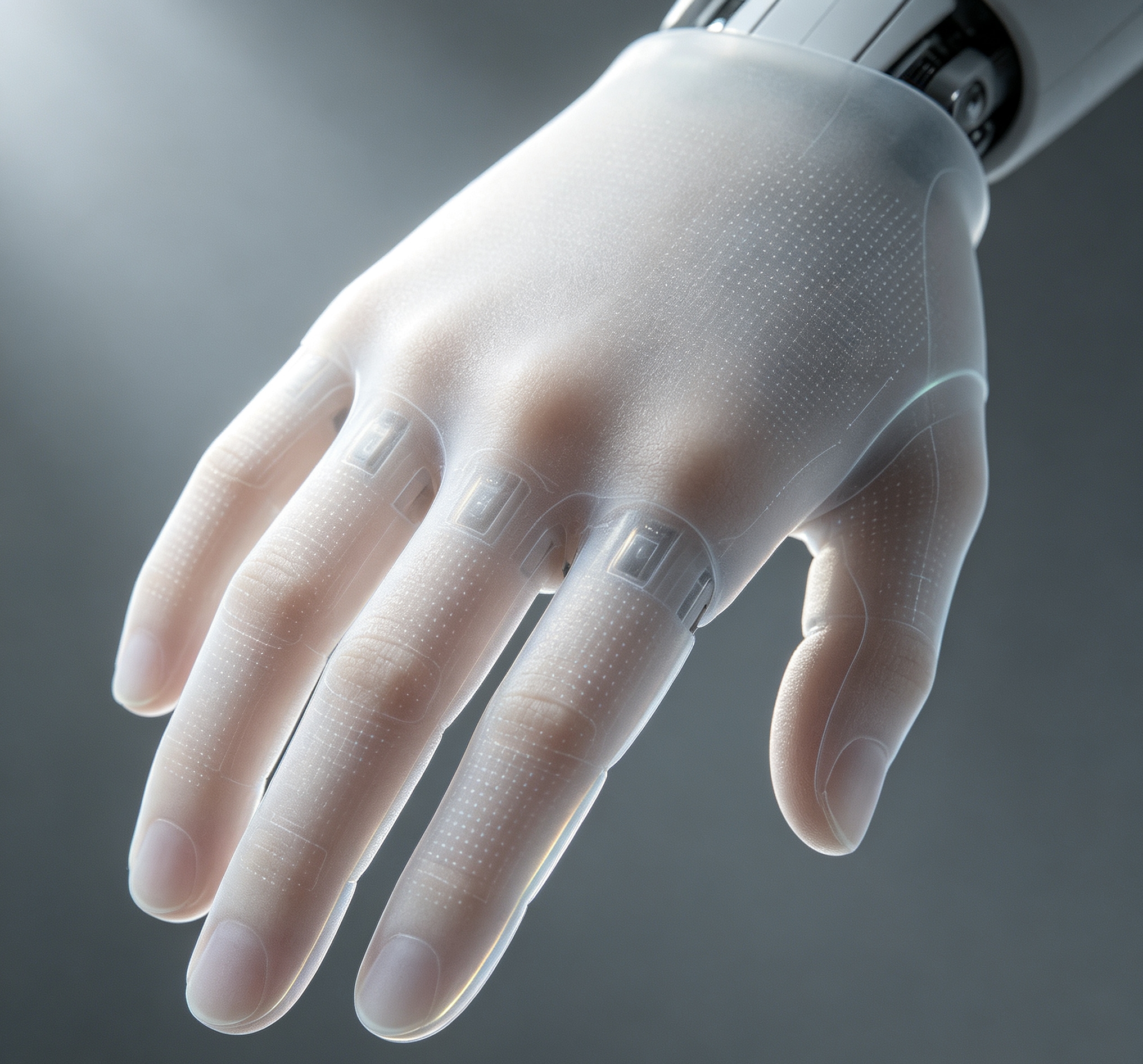 If you've ever watched a robot try to pick up an egg, you've seen the problem: cameras are great at seeing the world, but they're blind to touch. A machine can see the egg perfectly and still crush it, because it has no idea how hard it's gripping. A team at the University of Science and Technology of China (USTC) thinks the fix isn't a better camera — it's skin.
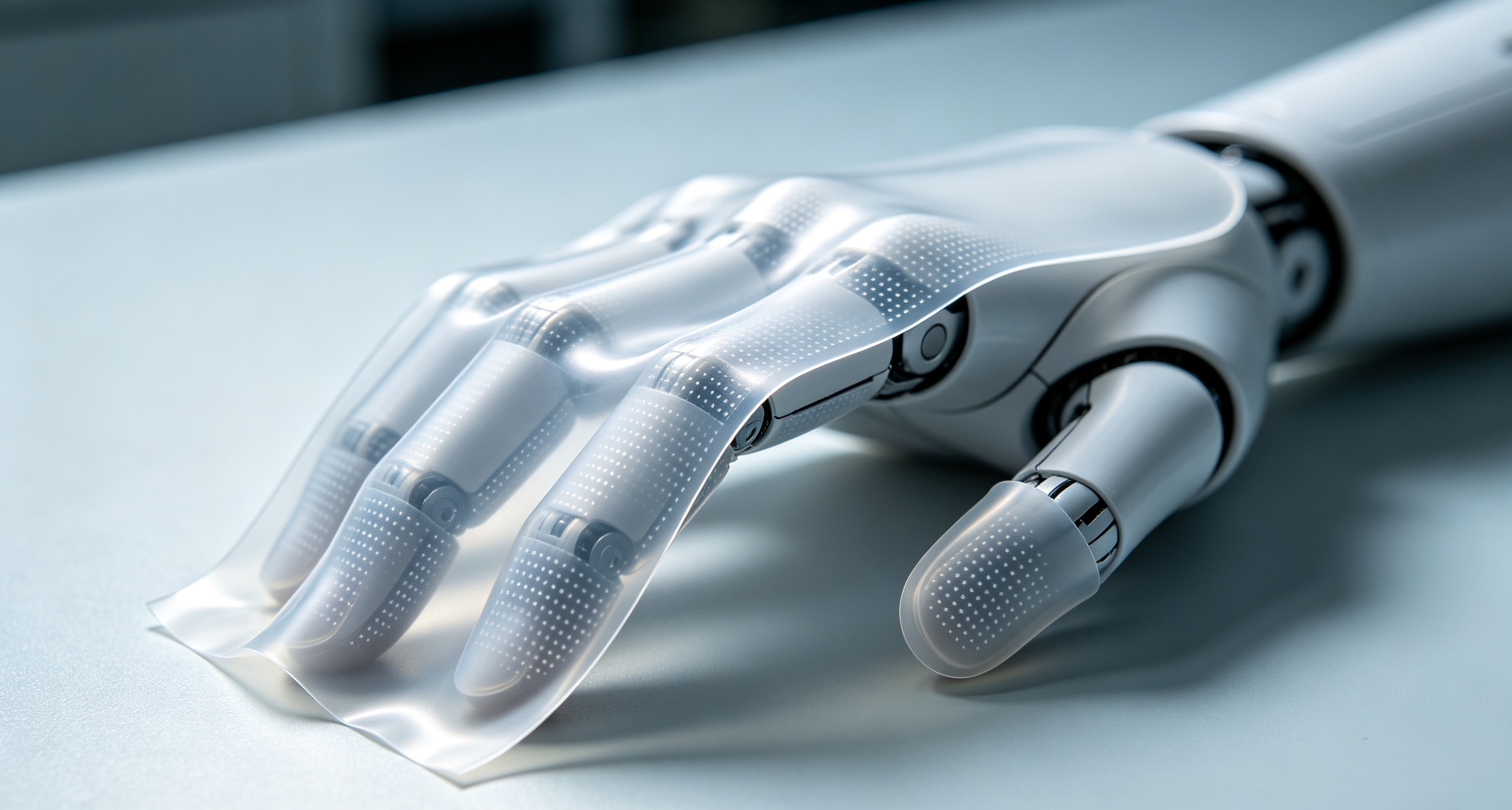
Their answer is a "bionic electronic skin": a flexible, paper-thin film that wraps around a robot's hand, arm, or even face and gives it something close to a human sense of touch. And the part that surprises people is what it's made from — crop waste.
Thinner than paper, softer than you'd expect
The film is just 0.1 millimeters thick — about the thickness of a sheet of tissue paper. Because it's flexible, it can hug any awkward shape: a robot's palm, its fingers, a curved panel, even a human face on a social robot. The surface is packed with tiny, high-density sensor points, and underneath runs an AI model that reads the signals in real time.
What can it actually feel? According to the project lead, Chang Zixuan, the skin simultaneously picks up the *magnitude and direction* of pressure, temperature changes, and even the sliding trajectory of an object — the tiny tell-tale movement that means "this is about to slip out of my grip." That's the kind of multi-dimensional tactile sensing that humans do without thinking but machines have always struggled with.
The clever bit is the material
Most advanced sensors are either brittle or expensive. This one sidesteps both. The core raw material is bio-based — derived from straw and other agricultural leftovers — which gives it a real cost edge. A single palm-sized patch of the sensor runs about 1,000 yuan (roughly $140). That's cheap enough to actually put on a product. The team also developed its own polyurethane film as the base and protective layer, which makes the skin tough and wear-resistant rather than fragile.
Getting from a lab prototype to something you could ship took cracking three hard problems: the material itself, the manufacturing process for densely packed sensor points, and the signal algorithm that turns raw readings into something an AI can use. They say all three are now solved.
Why this matters beyond the lab
The obvious first customer is humanoid robots. Today's robots are vision-heavy and touch-blind; the skin fills that blind spot, letting a machine sense a person or an obstacle the moment it makes contact — which is exactly what safe human-robot interaction needs. Picture a caregiving robot that feels how firmly it's holding someone's arm instead of guessing.
But the team is aiming wider. The same film could sit inside a car's smart seat, silently tracking a driver's posture and spotting fatigue. In a smart home, it could monitor how someone is sitting or sleeping and flag health changes — useful for elderly care and at-home health tracking without any wearables.
It's not just one lab — it's a wave
USTC's work is the headline this month, but it's part of a broader Chinese push into tactile sensing that's worth knowing about if you follow robotics:
- Nanjing University published a "skin-mimicking" system in *Nature Communications* that does the computing inside* the sensor itself, using frequency-division tricks to read a whole array of touch points at once with far less wiring and delay.
- Zhejiang University built a gel-based sensor that can tell how ripe a piece of fruit is by touch alone — useful for farm robots that need to pick produce without bruising it.
- On the industry side, companies like Weihai Juqiao are weaving sensors directly into fibers (the "fiber is the sensor" approach) and already supply tactile skins to humanoid-robot makers such as Unitree.
The numbers behind the hype are real, too. China accounted for about 44.7% of global electronic-skin patent filings, and the market for e-skin in embodied-AI robots was around $1.28 billion in 2025, with analysts forecasting a compound growth rate above 42% through 2030. Humanoid robots are the single biggest driver.
The takeaway for people outside China
For years, the robotics story out of China was "cheap hardware, decent vision." Touch is the next frontier, and a lab-to-product pipeline built on low-cost bio-based materials is exactly the kind of advantage that scales. When a robot can feel heat, pressure, and an impending slip — and do it for the price of a nice dinner — the gap between "demo robot" and "useful robot" gets a lot smaller.
China's electronic skin won't make headlines the way a flashy new model does. But give it a couple of years, and it may be the reason the robot in your home or hospital actually knows how to hold your hand.
If you've ever watched a robot try to pick up an egg, you've seen the problem: cameras are great at seeing the world, but they're blind to touch. A machine can see the egg perfectly and still crush it, because it has no idea how hard it's gripping. A team at the University of Science and Technology of China (USTC) thinks the fix isn't a better camera — it's skin.
Their answer is a "bionic electronic skin": a flexible, paper-thin film that wraps around a robot's hand, arm, or even face and gives it something close to a human sense of touch. And the part that surprises people is what it's made from — crop waste.
Thinner than paper, softer than you'd expect
The film is just 0.1 millimeters thick — about the thickness of a sheet of tissue paper. Because it's flexible, it can hug any awkward shape: a robot's palm, its fingers, a curved panel, even a human face on a social robot. The surface is packed with tiny, high-density sensor points, and underneath runs an AI model that reads the signals in real time.
What can it actually feel? According to the project lead, Chang Zixuan, the skin simultaneously picks up the *magnitude and direction* of pressure, temperature changes, and even the sliding trajectory of an object — the tiny tell-tale movement that means "this is about to slip out of my grip." That's the kind of multi-dimensional tactile sensing that humans do without thinking but machines have always struggled with.
The clever bit is the material
Most advanced sensors are either brittle or expensive. This one sidesteps both. The core raw material is bio-based — derived from straw and other agricultural leftovers — which gives it a real cost edge. A single palm-sized patch of the sensor runs about 1,000 yuan (roughly $140). That's cheap enough to actually put on a product. The team also developed its own polyurethane film as the base and protective layer, which makes the skin tough and wear-resistant rather than fragile.
Getting from a lab prototype to something you could ship took cracking three hard problems: the material itself, the manufacturing process for densely packed sensor points, and the signal algorithm that turns raw readings into something an AI can use. They say all three are now solved.
Why this matters beyond the lab
The obvious first customer is humanoid robots. Today's robots are vision-heavy and touch-blind; the skin fills that blind spot, letting a machine sense a person or an obstacle the moment it makes contact — which is exactly what safe human-robot interaction needs. Picture a caregiving robot that feels how firmly it's holding someone's arm instead of guessing.
But the team is aiming wider. The same film could sit inside a car's smart seat, silently tracking a driver's posture and spotting fatigue. In a smart home, it could monitor how someone is sitting or sleeping and flag health changes — useful for elderly care and at-home health tracking without any wearables.
It's not just one lab — it's a wave
USTC's work is the headline this month, but it's part of a broader Chinese push into tactile sensing that's worth knowing about if you follow robotics:
- Nanjing University published a "skin-mimicking" system in *Nature Communications* that does the computing inside* the sensor itself, using frequency-division tricks to read a whole array of touch points at once with far less wiring and delay.
- Zhejiang University built a gel-based sensor that can tell how ripe a piece of fruit is by touch alone — useful for farm robots that need to pick produce without bruising it.
- On the industry side, companies like Weihai Juqiao are weaving sensors directly into fibers (the "fiber is the sensor" approach) and already supply tactile skins to humanoid-robot makers such as Unitree.
The numbers behind the hype are real, too. China accounted for about 44.7% of global electronic-skin patent filings, and the market for e-skin in embodied-AI robots was around $1.28 billion in 2025, with analysts forecasting a compound growth rate above 42% through 2030. Humanoid robots are the single biggest driver.
The takeaway for people outside China
For years, the robotics story out of China was "cheap hardware, decent vision." Touch is the next frontier, and a lab-to-product pipeline built on low-cost bio-based materials is exactly the kind of advantage that scales. When a robot can feel heat, pressure, and an impending slip — and do it for the price of a nice dinner — the gap between "demo robot" and "useful robot" gets a lot smaller.
China's electronic skin won't make headlines the way a flashy new model does. But give it a couple of years, and it may be the reason the robot in your home or hospital actually knows how to hold your hand.
Advertisement
Views: —