Google Tried This and Gave Up. China Just Flew a Power Plant to 13,000 Feet.
SinoTechLens•2026-08-29
China's S4000 just flew a working power plant to 13,000 feet and generated electricity up there. Google's Makani burned ...
Advertisement
China's S4000 just flew a working power plant to 13,000 feet and generated electricity up there. Google's Makani burned years on this and folded. Here's what changed.
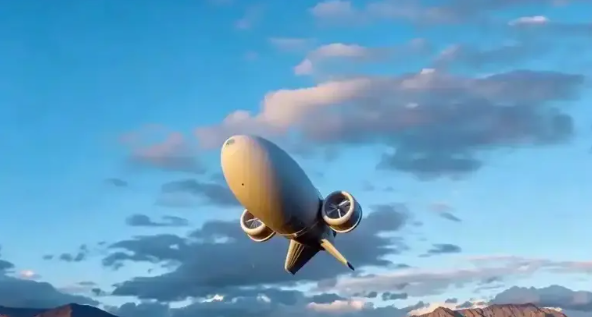 One correction before anything else, because it keeps getting repeated. The system that just carried a working power plant up to 13,000 feet over northwest China is held up by helium, not hydrogen. That's the difference between clever engineering and a 220-foot Hindenburg with a generator bolted underneath. Worth getting right.
What happened is this. A company called SAWES, the English name for Beijing Linyi Yunchuan, ran its S4000 system through a complete mission at a test site in northwest China and announced the results in late August. Launch. Station-keeping. Power generation. Recovery. All of it. Nobody had ever taken an airborne wind system to 4,000 meters and made electricity there before.
Picture a blimp, and I mean a real one. The S4000 measures 67 meters long, 40 wide, 23 tall. That's roughly 220 feet, which puts it in 747 territory, and it is a strange thing to say about a power plant. It floats up on helium, parks in the wind stream, runs generators inside a duct, and sends the electricity back down a tether. Design life is 20 years.
The reason anyone bothers with this is a piece of physics that sounds made up. Power available in wind scales with the cube of wind speed. Double the speed, eight times the energy. Triple it, twenty-seven times. Up high, the air not only moves faster, it moves steadily instead of gusting, which matters just as much for a machine trying to make consistent power. SAWES and its research partners at the Aerospace Information Research Institute and Tsinghua put high-altitude wind energy density near 10 kilowatts per square meter, tens of times what a ground-level wind farm sees. Discount it for promotional arithmetic if you want. The gap is still huge.
And this wasn't a lucky one-off, which is the part most coverage skips. The team started working on the underlying principles in 2017. Since then: the S500 hit 500 meters over Hubei in late 2024 at 50 kilowatts. The S1000 reached 1,000 meters a few months later at double that. The S1500 flew over Hami in Xinjiang in September 2025, hitting 1,500 meters and a full megawatt from twelve 100-kilowatt turbine sets arranged in a ring, the first megawatt-scale machine of its kind. The S2000 went up in January out of Yibin in Sichuan, built as a megawatt system for urban settings. Now S4000 at 4,000 meters. An S6000 is already on the boards. Four generations in under two years.
Here's what should bother people in the U.S. We had this idea first, or at least we had it earlier and we quit. Makani, the tethered-kite outfit Alphabet bought in 2013, spent years on airborne wind and got shut down in 2020 without ever shipping a commercial product. Altaeros came out of MIT with a buoyant turbine and is still grinding at a fraction of this scale. Some of the theory traces back to Qian Xuesen, who worked on wind-amplification ducts in the 1950s before returning to China to essentially build its space program. The concept sat around for decades. A company almost no American has heard of went and flew it.
I'm not going to pretend this is solved. One clean mission cycle at a test range is a long way from twenty years of unattended operation, and tethered aircraft have an ugly history with thunderstorms. Airspace regulation is going to be a genuine nightmare, and a 220-foot inflatable power station parked at 13,000 feet will have a memorable conversation with the FAA, never mind anyone trying to fly near it. The cost claims making the rounds, 40% less material and 30% cheaper electricity than a conventional turbine, are company numbers. Company numbers are marketing until an outside operator verifies them.
What makes me take it seriously anyway is the deployment math. A normal onshore turbine needs a tower, a foundation, and a crane big enough to make you wince at the invoice. This thing reportedly folds into a container, gets trucked in, inflates, and goes to work. That's a real product for a mine in the middle of nowhere, an island burning diesel, or a town that just lost its grid in a flood. Those aren't the customers who decide the future of energy, but they pay actual money right now, and companies that eventually get cheap almost always start there.
High-altitude wind is written into China's 15th Five-Year Plan for renewable energy now, which means it has funding and a runway whether or not this particular machine pans out. Last month it flew, made power, and came home in one piece. Everything after that is engineering. Engineering is the part I'd never bet against.
One correction before anything else, because it keeps getting repeated. The system that just carried a working power plant up to 13,000 feet over northwest China is held up by helium, not hydrogen. That's the difference between clever engineering and a 220-foot Hindenburg with a generator bolted underneath. Worth getting right.
What happened is this. A company called SAWES, the English name for Beijing Linyi Yunchuan, ran its S4000 system through a complete mission at a test site in northwest China and announced the results in late August. Launch. Station-keeping. Power generation. Recovery. All of it. Nobody had ever taken an airborne wind system to 4,000 meters and made electricity there before.
Picture a blimp, and I mean a real one. The S4000 measures 67 meters long, 40 wide, 23 tall. That's roughly 220 feet, which puts it in 747 territory, and it is a strange thing to say about a power plant. It floats up on helium, parks in the wind stream, runs generators inside a duct, and sends the electricity back down a tether. Design life is 20 years.
The reason anyone bothers with this is a piece of physics that sounds made up. Power available in wind scales with the cube of wind speed. Double the speed, eight times the energy. Triple it, twenty-seven times. Up high, the air not only moves faster, it moves steadily instead of gusting, which matters just as much for a machine trying to make consistent power. SAWES and its research partners at the Aerospace Information Research Institute and Tsinghua put high-altitude wind energy density near 10 kilowatts per square meter, tens of times what a ground-level wind farm sees. Discount it for promotional arithmetic if you want. The gap is still huge.
And this wasn't a lucky one-off, which is the part most coverage skips. The team started working on the underlying principles in 2017. Since then: the S500 hit 500 meters over Hubei in late 2024 at 50 kilowatts. The S1000 reached 1,000 meters a few months later at double that. The S1500 flew over Hami in Xinjiang in September 2025, hitting 1,500 meters and a full megawatt from twelve 100-kilowatt turbine sets arranged in a ring, the first megawatt-scale machine of its kind. The S2000 went up in January out of Yibin in Sichuan, built as a megawatt system for urban settings. Now S4000 at 4,000 meters. An S6000 is already on the boards. Four generations in under two years.
Here's what should bother people in the U.S. We had this idea first, or at least we had it earlier and we quit. Makani, the tethered-kite outfit Alphabet bought in 2013, spent years on airborne wind and got shut down in 2020 without ever shipping a commercial product. Altaeros came out of MIT with a buoyant turbine and is still grinding at a fraction of this scale. Some of the theory traces back to Qian Xuesen, who worked on wind-amplification ducts in the 1950s before returning to China to essentially build its space program. The concept sat around for decades. A company almost no American has heard of went and flew it.
I'm not going to pretend this is solved. One clean mission cycle at a test range is a long way from twenty years of unattended operation, and tethered aircraft have an ugly history with thunderstorms. Airspace regulation is going to be a genuine nightmare, and a 220-foot inflatable power station parked at 13,000 feet will have a memorable conversation with the FAA, never mind anyone trying to fly near it. The cost claims making the rounds, 40% less material and 30% cheaper electricity than a conventional turbine, are company numbers. Company numbers are marketing until an outside operator verifies them.
What makes me take it seriously anyway is the deployment math. A normal onshore turbine needs a tower, a foundation, and a crane big enough to make you wince at the invoice. This thing reportedly folds into a container, gets trucked in, inflates, and goes to work. That's a real product for a mine in the middle of nowhere, an island burning diesel, or a town that just lost its grid in a flood. Those aren't the customers who decide the future of energy, but they pay actual money right now, and companies that eventually get cheap almost always start there.
High-altitude wind is written into China's 15th Five-Year Plan for renewable energy now, which means it has funding and a runway whether or not this particular machine pans out. Last month it flew, made power, and came home in one piece. Everything after that is engineering. Engineering is the part I'd never bet against.
One correction before anything else, because it keeps getting repeated. The system that just carried a working power plant up to 13,000 feet over northwest China is held up by helium, not hydrogen. That's the difference between clever engineering and a 220-foot Hindenburg with a generator bolted underneath. Worth getting right.
What happened is this. A company called SAWES, the English name for Beijing Linyi Yunchuan, ran its S4000 system through a complete mission at a test site in northwest China and announced the results in late August. Launch. Station-keeping. Power generation. Recovery. All of it. Nobody had ever taken an airborne wind system to 4,000 meters and made electricity there before.
Picture a blimp, and I mean a real one. The S4000 measures 67 meters long, 40 wide, 23 tall. That's roughly 220 feet, which puts it in 747 territory, and it is a strange thing to say about a power plant. It floats up on helium, parks in the wind stream, runs generators inside a duct, and sends the electricity back down a tether. Design life is 20 years.
The reason anyone bothers with this is a piece of physics that sounds made up. Power available in wind scales with the cube of wind speed. Double the speed, eight times the energy. Triple it, twenty-seven times. Up high, the air not only moves faster, it moves steadily instead of gusting, which matters just as much for a machine trying to make consistent power. SAWES and its research partners at the Aerospace Information Research Institute and Tsinghua put high-altitude wind energy density near 10 kilowatts per square meter, tens of times what a ground-level wind farm sees. Discount it for promotional arithmetic if you want. The gap is still huge.
And this wasn't a lucky one-off, which is the part most coverage skips. The team started working on the underlying principles in 2017. Since then: the S500 hit 500 meters over Hubei in late 2024 at 50 kilowatts. The S1000 reached 1,000 meters a few months later at double that. The S1500 flew over Hami in Xinjiang in September 2025, hitting 1,500 meters and a full megawatt from twelve 100-kilowatt turbine sets arranged in a ring, the first megawatt-scale machine of its kind. The S2000 went up in January out of Yibin in Sichuan, built as a megawatt system for urban settings. Now S4000 at 4,000 meters. An S6000 is already on the boards. Four generations in under two years.
Here's what should bother people in the U.S. We had this idea first, or at least we had it earlier and we quit. Makani, the tethered-kite outfit Alphabet bought in 2013, spent years on airborne wind and got shut down in 2020 without ever shipping a commercial product. Altaeros came out of MIT with a buoyant turbine and is still grinding at a fraction of this scale. Some of the theory traces back to Qian Xuesen, who worked on wind-amplification ducts in the 1950s before returning to China to essentially build its space program. The concept sat around for decades. A company almost no American has heard of went and flew it.
I'm not going to pretend this is solved. One clean mission cycle at a test range is a long way from twenty years of unattended operation, and tethered aircraft have an ugly history with thunderstorms. Airspace regulation is going to be a genuine nightmare, and a 220-foot inflatable power station parked at 13,000 feet will have a memorable conversation with the FAA, never mind anyone trying to fly near it. The cost claims making the rounds, 40% less material and 30% cheaper electricity than a conventional turbine, are company numbers. Company numbers are marketing until an outside operator verifies them.
What makes me take it seriously anyway is the deployment math. A normal onshore turbine needs a tower, a foundation, and a crane big enough to make you wince at the invoice. This thing reportedly folds into a container, gets trucked in, inflates, and goes to work. That's a real product for a mine in the middle of nowhere, an island burning diesel, or a town that just lost its grid in a flood. Those aren't the customers who decide the future of energy, but they pay actual money right now, and companies that eventually get cheap almost always start there.
High-altitude wind is written into China's 15th Five-Year Plan for renewable energy now, which means it has funding and a runway whether or not this particular machine pans out. Last month it flew, made power, and came home in one piece. Everything after that is engineering. Engineering is the part I'd never bet against.
Advertisement
Views: —